Will's Journey: From 'Wanting to be normal' to 'Be who you are' - NDIS In Australia

Updated: Mar 12
'I just wanted to be normal' was one of the first comments mentioned as we sat in the backyard for a sit-down interview with Will.
Towards the end of the interview, his final comments spoke the words "It doesn't matter what you have, just be who you are… it's not only you… everyone's going through different things."
Two very different statements, meaning so much for this young man. Yet unknown to him, these words would be impactful to those around and listening.
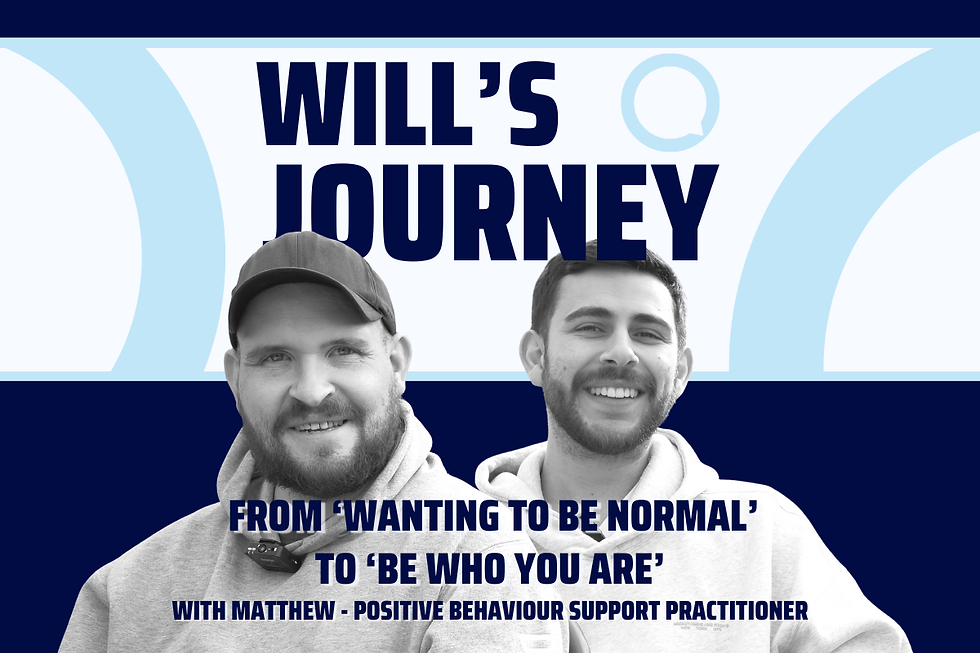
Will shared his voice with us that day, and we feel privileged to share his story with you.
We spent about an hour or so sitting in the backyard chatting to Will. He mentioned "I don't like talking about my life that much but…", for that day he opened up as we all shared a bit about ourselves together. A safe space was created.
When I say 'we', I mean the three of us: myself (Carson, behind the camera), Matthew 'Matty' (the Positive Behaviour Support Practitioner), and of course Will. It was casual, yet memorable.
Using a fold-out trestle table and three chairs, we sat and had a chat over a bunch of different topics. Finding out about Will’s upbringing, his family, his interests and hobbies, and the array of jobs from his past and present… all sorts of stuff really.
An initial shock of worry happened as Will's chair broke as one of the feet was partially off the concrete, slipping and snapping into the dirt partway through the chat. Luckily, he was okay. He had a laugh, brushed himself off and wanted to chat more. First thing he said was 'You should put that on funniest home videos… send that to my mum please.' as he chuckled. We cracked up laughing, and I gave him my chair and decided to film kneeling (apologies for any shaky footage if you watch the content!).
Right after, I asked Will what he'd like to speak about. We brought up his diagnosis and he said,
"We can talk about that… it's in my head 24/7 anyway."
Right away I saw a person sitting in front of me with a kind heart, humorous with some quick wittedness about him through his use of sarcasm and friendly banter with Matty. Will shared more of his voice after that.
Understanding 48, XXYY Syndrome

He spoke towards the diagnosis he received at the age of seven. A rare disability called 48, XXYY syndrome. He told me it only occurs in males. This is true, it doesn't occur in females, only males where they obtain an extra X and Y chromosome at birth instead of the usual 46, XY.
Understanding this diagnosis is important because there's no 'cure' for this type of condition; however, some symptoms can be managed. Quite often the public think a lot of disabilities/health challenges can be "cured" or "fixed", but these remarks can be made from ignorance or lack of perspective. We want to move away from this lens of "cured" or "fixed" and instead focus on equity. How can we accommodate for each other, accept & celebrate our differences in society. Using the right strategies, support systems, and environments to help with this.
For Will, he isn't trying to become someone he's not. Instead, he's been navigating his identity, relationships, and self-acceptance along his journey with the support of others, which is lovely to see.
He also spoke about how people who have it are usually physically larger (e.g., taller in stature, broader, etc); Will is 6ft 3in by the way. They also have issues with hormones and reproduction due to most having infertility. Will can't have kids unfortunately.
It's quite a complex diagnosis that involves neurodevelopmental difficulties, which is another reason why we assist Will with our support services too. Neurologically speaking, there is a higher risk of developmental delays, learning difficulties, obtaining ADHD, and autism spectrum traits and symptomologies.
He also brought this up with us, and how he's made quite a few friends who have a diagnosis of ADHD and/or autism as well.
Another thing Will spoke to was his ongoing experience with hand tremors, emotional regulation (e.g., anger management), learning frustrations, and openness towards his historical struggles with mental health and suicidal ideation, which he found to be quite challenging over time for an array of reasons.
The Turning Point
Here's the thing though, Will, regardless of having this diagnosis and with the challenges he has faced and faces, was quite happy that day. Shy at first, yet happy. And from Matty's comments, Will had been doing well for some time now.
I wanted to dive into the 'why' behind all of this, thinking about the progress and journey he would have been through to get to this stage of personal growth.
"So, what changed?" Matty asked Will.
"That baby was born, and he has the same disability as me…" he said.
Will mentioned, there weren’t many people at all with the same disability as him in Australia. He said there was only 7 before that baby was born.
Speaking towards Will's mental health, Matty asked what got you out of that state though?

Will responded, "When I met him in person, I just got out of it… the baby was born with the same disability as me…" Will proceeded to mention he wanted the child to "just have the best life that's possible," and proceeded to look up in the sky smiling in awe. Will felt less alone in this world when the baby was born with the same diagnosis and hopes to be a mentor for this child in the future.
This comment came from a person who felt that they needed to act like they don't have a disability in this world to belong. And wanted to not be in this world with us to experience life at the age of 20 because he thought he wasn't normal like everyone else. Questioning if he belonged in this world.
It did show that the self-questioning of belonging did reduce as he continued his journey towards ‘a good life’.
Building a Good Life with NDIS Support in Australia:

With the support of his family, friends, and NDIS support services in Australia. Will was determined for personal growth.
He started to see a psychologist for a period of time for his mental struggles after the baby being born as he was still combatting conflicting thoughts. He found a new Supported-Independent Living (SIL) arrangement with new employees that suited his lifestyle, routine, and personality. He's been meeting new people and spends more time with his family. Connection is a true value of his.

Will continued to speak about his jobs. Mentioning he used to work in a butcher job at a younger age, but now enjoys landscaping, water pressuring, and whipper-snipping more. I proceeded to ask if he enjoys it because of the therapeutic benefits, but instead he said aside from being outside, it was because it was a way for him to help people who couldn't do it themselves. Will said "you just do it for them." Like I said, a kind-hearted person.

We also spoke about Will’s engagement and support to the LGBTQIA+ community. He opened up about his own experience of self-discovery identifying as bisexual and knew from a young age. To be involved with the community more, he’s attended pride events and even dressed up as a drag queen before. I showed him some photos & videos of my brother during his drag-queen events, and he loved seeing them. He cherishes this community.
Another area of progression for Will was finding alternative ways to express emotions like frustration or anger. He mentioned he used to punch brick walls, headbutt windows, and even engage in physical sparring. During these conversations Will proceeded to show us his knuckles with marks on them. However, after an environmental change and additional supports, he has other methods now. Using breathing techniques, thought diversion techniques, using a stress ball, and even simply punching a boxing bag all help him. He also goes to the gym, and has his own personal goals. How incredible is that!
Will's Message to Others

Reaching the end of our chat, I asked Will if he had a final message for anyone that would be watching this, and he said, "It doesn't matter what you have, just be who you are… it's not only you… everyone's going through different things."
As he shared his voice from that statement alone, it was made known why Will was as happy and content at the end of that day. I think he knew how far he has come in his personal growth and development. And look… if he was happy for some other reason, we want him to know we can see it.
What we can Learn
So, what can we learn from Will's story? His journey reminds us that self-acceptance and authenticity matter deeply. When we stop trying to fit into moulds that were never made for us, we create space for genuine growth. Will's story also shows us that everyone's journey is unique and rarely follows a straight line, progress comes with setbacks, breakthroughs happen in unexpected moments, and healing doesn't follow a timetable.
Perhaps most importantly, Will's experience highlights how essential connection and community are in shaping who we become. Whether it's family, friends, support workers, or even a child who shares your diagnosis, these relationships can provide the mirrors we need to see our own worth and potential. Will's voice matters, not despite his circumstances, perspective, and experience, but because of them.
And finally, Will's transformation teaches us something profound: Every life born on this earth has its place and belonging. His journey from wanting to be "normal" to encouraging others to "just be who you are" isn't just about acceptance, it's about recognising that our differences, our struggles, and our unique paths all contribute to the human experience. We all have something valuable to offer, and we all deserve to be heard.
A Practitioner's Perspective
After the interview, I asked Matty to share some thoughts on Will and his story:

"Will is a kind, generous, and thoughtful person that I have been so grateful to work with over the last 12 months. He isn't afraid to speak his mind, and it has been a privilege to learn about him through face-to-face meetings and phone calls. He has a big heart and is considerate of how he might make others feel through his thoughts, feelings and actions. Although the content recorded might just show a bit of banter between mates, what I am most proud of is Will's ability to sit in uncomfortability and share things that might be difficult to express. He never wants anyone to feel upset by anything and is aware of how he may or may not be in control of his emotions, which is admirable.
I look forward to continuing to work with Will, his family, and his formal supports in 2026, showcasing how Positive Behaviour Support can work together to keep kicking Will's goals and promoting Will's quality of life."
Lovely take from Matty.
At My Right 2 Voice, we believe that every person, regardless of their diagnosis, identity, or circumstances, deserves to have their voice amplified, respected, and celebrated.
Will's story reminds us why this work matters. When we create spaces where people can be authentically themselves, where connection is prioritised over conformity, and where every voice is valued, that's when real empowerment happens.
Join the Conversation:
Will's story is just one of many we're privileged to share. Each person we support brings unique perspectives, experiences, and wisdom that enrich our understanding.
If you or someone you care about would like to share their voice through story, or if you're seeking disability services that truly put the individual at the centre, we'd love to hear from you.
Because every voice deserves to be heard. Including yours.
VOICE CAMPAIGN 2026: Share Your VOICE
For more stories like this, get involved in our annual awareness campaign run throughout April.
It's called VOICE, and it aims to empower voices, drive change, & challenge stigma for the disability & mental health community.
We invite anyone to participate (People with lived exp. families, friends, advocates, workers) by sharing stories, experiences or a message to create positive change, inclusivity, & equity for our community.
For all other enquiries:
Additional Context on 48, XXYY Syndrome
Now for those keen readers at home, here are a couple more details we'd love to share, and below we have some additional resources for you to add to your research.
A little more context to the disability and rarity of it:
Only seven people have it currently in Australia from Will's comments
Will's doctor is from California, because there isn't a specialist for this disability here in Australia for him
The prevalence rates aren't too accurate online, most say it's upwards of 1 in 50,000 male births. Some papers say 18,000–40,000
Most research is based in America. Outside of general online government health information, there were four research papers I found, three of which were US-based, mentioning "48,XXYY is one of the most under-studied and rare types of sex chromosome"
Websites/Articles: 48, XXYY
National Organisation for Rare Disorders (NORD). (n.d.). 48,XXYY Syndrome. NORD (National Organisation for Rare Disorders). https://rarediseases.org/rare-diseases/48-xxyy-syndrome/
MedlinePlus, Bethesda (MD): National Library of Medicine (US);. 48,XXYY syndrome; MedlinePlus: https://medlineplus.gov/genetics/condition/48xxyy-syndrome/
Rare Chromosome Disorder Support Group. (n.d.). XXYY syndrome. Rare Chromosome Disorder Support Group. rarechromo.org
Papers:
Hanley, A. P., Blumenthal, J. D., Lee, N. R., Baker, E. H., Clasen, L. S., & Giedd, J. N. (2015). Brain and behaviour in 48, XXYY syndrome. NeuroImage: Clinical, 8, 133-139.
Razali, N. A., Mohd Daud, T. I., Woon, L. S. C., Mohamed Saini, S., Muhammad, N. A., & Sharip, S. (2023). Case report: Bipolar disorder in 48, XXYY syndrome. Frontiers in psychiatry, 13, 1080698.
Dreyer, J., Howell, S., Bothwell, S., Molison, K., Carl, A., Swenson, K., ... & Tartaglia, N. (2025). Psychotropic Medication Use in 48, XXYY Syndrome. American Journal of Medical Genetics Part A, e64077.
This article is part of our ongoing series celebrating the voices, experiences, and wisdom of the individuals we're privileged to support. Through sharing these stories, we hope to create a greater understanding, connection, and empowerment within the disability community and beyond.
Related short-form content exploring specific aspects of Will's journey, including identity, connection, family dynamics, and his message to others, is available across our social media platforms.


Comments